
The Problem with LLMs (And Why RAG Exists)
Large Language Models like ChatGPT and GPT-4 are incredibly powerful- but they come with a key limitation: they don't have access to your real-time or private data.
- Outdated Knowledge- Models are trained on past data and may not know recent updates.
- No Private Context- They can't access your company documents, PDFs, or databases.
- Hallucinations- Sometimes they generate confident but incorrect answers.
This is where Retrieval-Augmented Generation (RAG) becomes essential. Instead of relying only on memory, RAG allows AI to look up information before answering.
What is RAG Architecture?
RAG is an architecture that combines two systems:
- Retriever- Finds relevant information
- Generator (LLM)- Uses that information to generate answers
Think of RAG like an open-book exam: without RAG you answer from memory, with RAG you first check the book, then answer. This makes responses more accurate, grounded, and reliable.
1. Data Ingestion (Foundation of Everything)
Before building a RAG system, you need data- PDFs, websites, databases. What actually happens here:
- Text is extracted from files
- Noise is removed (headers, footers, irrelevant content)
- Data is standardized into a consistent format
If this step is weak, your entire RAG system will produce poor results.
2. Chunking (Breaking Data Intelligently)
Since LLMs cannot process extremely long documents at once, we split them into smaller pieces called chunks. Poor chunking breaks meaning- splitting "The company's revenue increased due to strong Q4 sales" into two chunks loses the relationship between cause and effect.
- Small chunks- Better retrieval but less context
- Large chunks- More context but less precision
- Advanced techniques- Overlapping chunks, semantic chunking (based on meaning, not size)
3. Embeddings (Turning Text into Meaningful Numbers)
Embeddings convert text into vectors (numerical representations). These vectors capture semantic meaning, not just keywords- "car" and "vehicle" will have similar vectors, while "car" and "banana" will be far apart.
- Popular tools: OpenAI Embeddings, Sentence Transformers
- This enables semantic search instead of keyword search
4. Vector Database (Where Knowledge is Stored)
Once embeddings are created, they are stored in a vector database. It allows fast retrieval of "similar" vectors using techniques like cosine similarity and Euclidean distance.
- Popular options: FAISS, Pinecone
- Think of it as a Google search engine, but for meaning instead of keywords
5. Query Processing (Understanding the User Question)
When a user asks a question, the system converts the query into an embedding, searches the vector database, and retrieves the top relevant chunks. The system doesn't "understand" the query like a human- it finds similar meaning in vector space.
6. LLM Generation (Final Answer Creation)
The retrieved chunks are passed into an LLM like GPT-4. The LLM reads the retrieved context, combines it with the query, and generates a natural language response. The answer is now grounded in real data, more accurate, and less hallucinated.
End-to-End RAG Flow
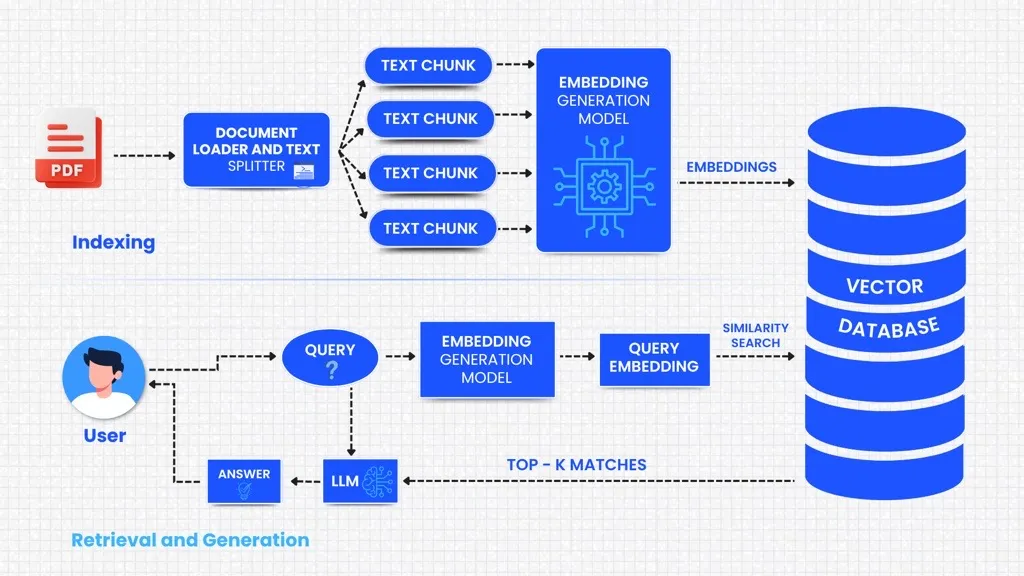
Each step contributes to accuracy- skip one, and performance drops.

Limitations of RAG
- Context Loss Due to Chunking- Splitting documents can break meaning and relationships.
- Similarity ≠ Correctness- Just because something is "similar" doesn't mean it's the right answer.
- Embedding Dependency- If embeddings are weak, retrieval quality suffers.
- Complex Infrastructure- Needs pipelines, databases, and indexing, adding overhead.
Real-World Applications
- Chatbots- Customer support where AI answers based on company documents instead of guessing.
- Knowledge Assistants- Employees can query internal documentation instantly.
- Legal Systems- Helps lawyers search large contracts without missing context.
- E-commerce- Provides accurate product answers based on catalogs and specs.
The Future of RAG
RAG is evolving into more advanced systems:
- Hybrid search (keyword + semantic)
- Graph-based retrieval
- Multi-modal RAG (text + images)
- Reasoning-based systems like PageIndex
RAG Architecture is a major step toward making AI truly useful in real-world applications- transforming AI from a guessing machine into a knowledge-grounded assistant. But as we've seen, it's still evolving.

